
Greensboro Resident Lookup Records
Use each record for the narrow fact it can support. A Guilford property card can identify an owner and the tax mailing address, while a voter result can confirm registration status and civic geography for a searched name. Neither establishes every person at an address. Court and vital-record results have their own access limits, and older Greensboro directories can establish an address in a particular era rather than a current location.
| Record | What It Confirms | Where | Access |
|---|---|---|---|
| Property card | Parcel owner, mailing and situs addresses, deed reference | Guilford NCPTS | Free county portal |
| Voter record | Registration status, precinct, districts, polling place and history | NC Voter Search | Public fields subject to state protections |
| Court register | Public case, party, event, disposition or judgment reference | eCourts Portal | Public summary, with clerk access for more |
| Vital record | Whether an event may be documented and which custodian holds it | NC Vital Records | Certified copies have eligibility rules |
| Directory or burial source | Historical address, published listing, or burial endpoint | Greensboro library and city collections | Mixed online and research-room access |
When an address is known, begin with the property card and preserve the REID or PIN, situs address, owner name, mailing address, legal description, and deed book and page. When only a name is known, the voter search or a court party search can supply a narrower civic or case clue. A historical question calls for a dated directory, newspaper, burial index, deed, or estate record instead of a current-property assumption.
The order changes with the question. A name plus a current street address is strongest in the parcel card first, then the voter status or a court result. A name plus a death date belongs in the burial, obituary, vital, and estate routes. An old address should be checked against a directory year and the deed description before it is joined to a modern parcel. Record the name spelling, date searched, and source URL for every candidate. That small log makes conflicting results visible instead of quietly combining them.
Match a Greensboro Resident Name
A Greensboro resident lookup works best as a cross-check, not as one result. Compare middle initials, suffixes, former or married names, business names, street labels, and date ranges. A common name is not enough. The tax mailing address may be outside Greensboro, and even a Greensboro situs address proves the parcel location rather than present occupancy. A voter record may be inactive, removed, or protected. A directory can omit household members or use an abbreviation.
For a current address question, use this sequence. It keeps the record trail focused and leaves an auditable reason for each match.
- Search NCPTS by owner name or address and record the REID or PIN, situs, mailing address, legal description, and deed book/page.
- Search the person in NC Voter Search with first name, last name, the Guilford County filter when useful, and a selected status category.
- Search the eCourts Portal for party-name variants. Capture the case number, county, filing date, case type, status, and disposition rather than relying on a name alone.
- For an older connection, compare a dated Greensboro directory, obituary or burial result, estate file, or recorded deed with the same name and address era.
- REID / PIN
- A county parcel identifier that ties a property-card result to map and tax information.
- Docket or Register of Actions
- The running public case summary showing filings, parties, events, and outcomes where access is allowed.
- Index versus image
- An index lists searchable references such as names and book/page numbers. An image is the scanned source document and may require a separate route.
- Certified copy
- A copy issued by the lawful custodian with its certification. It is different from an index entry or an ordinary informational copy.
Greensboro Resident Property Cards
NCPTS searches by parcel number, owner name, or street address. Its detailed card can show the owner, mailing address, situs address, legal description, deed book/page and date, transfers, values, improvements, tax fields, and map route. The two addresses deserve separate notes. The situs is where the taxable parcel sits. The mailing address is where the tax system sends correspondence. They can be different cities, as the inspected county example showed.
Insider tip. Capture both the mailing and situs addresses before treating a property result as a resident match. An outside mailing address can be a perfectly normal tax correspondence choice and does not identify who occupies the parcel.
The current property card also creates a useful historical bridge. Its deed reference can be taken to the Guilford Register of Deeds real-estate search, then checked against grantor, grantee, legal-description, acreage, plat, and book/page details. Guilford says its online records reach back to 1771, but the research did not verify a uniform image cutoff. Older or missing material may require the Register, microfilm, the library deed guide, or the State Archives.
Confirm a Greensboro Resident's Voter Status
The state Voter Search asks for first name and last name, permits an optional middle initial, birth year, and county, and requires at least one status choice: Registered or Removed or Denied. A result can show registration status, jurisdictions, polling place, sample ballot when available, absentee information, and voting history. Full date of birth, Social Security information, driver-license information, and protected addresses are not public result fields.
The following image comes from the official NC Voter Search referenced in the image manifest. Its controls illustrate why the county and status choices should be saved with the search date.
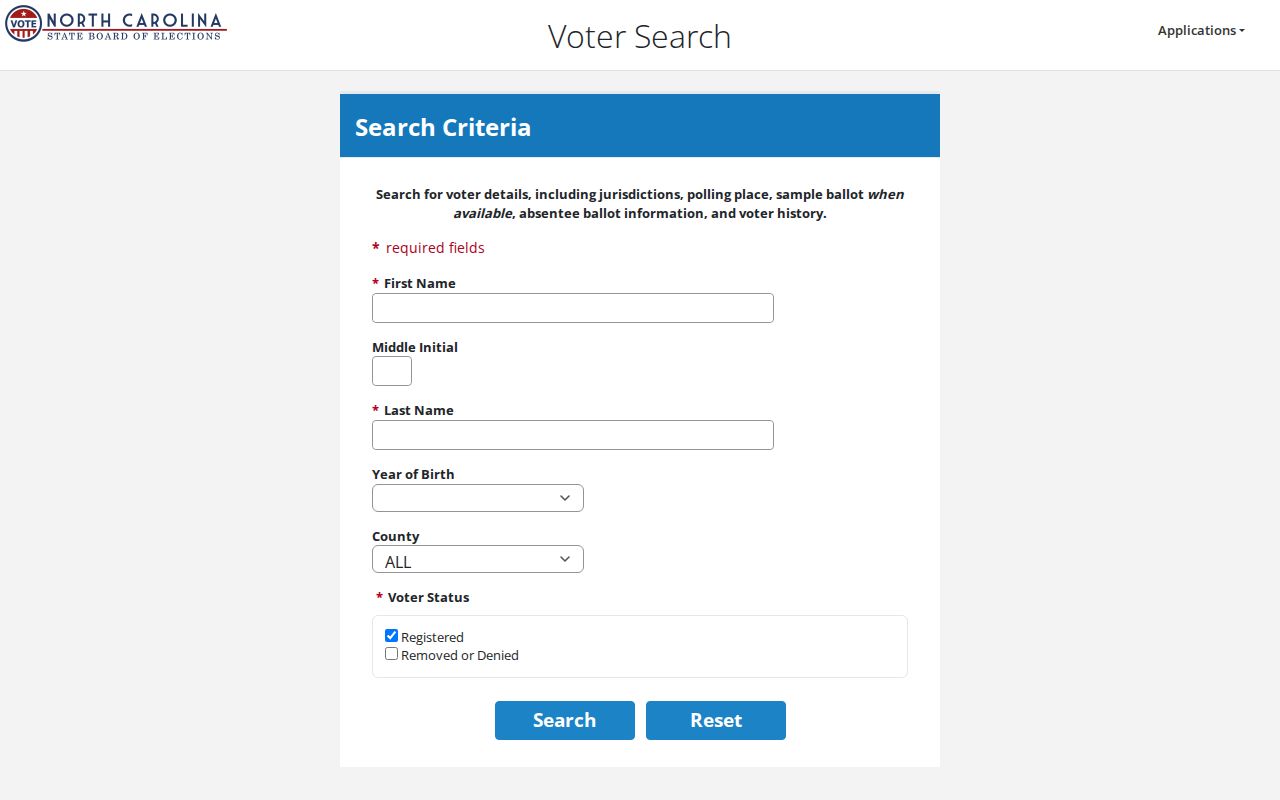
Registration files are refreshed weekly, so a later status can differ without proving that an earlier result was wrong. Use the result for a civic check, such as precinct or polling place, then compare it with an independent parcel, directory, deed, or case source. Do not infer a complete household from one voter result.
Greensboro Resident Court and Vital Routes
North Carolina completed eCourts implementation in all 100 counties in October 2025. The eCourts Portal Smart Search can return public case summaries, party information, events, dispositions, hearings, and financial information where applicable. It also has advanced filters for location, case type, status, filing date, party, and other available details. A Portal result is not the complete paper file. Sealed, juvenile, expunged, protected family-law, and other restricted material will not appear, and a clerk terminal remains the route for permitted file review or copies.
Portal search terms have documented limits. A party last name needs at least three characters followed by an asterisk, and a first name needs at least one character followed by an asterisk. Case-number and hearing-search options can narrow a result further. Read the county, parties, event dates, and disposition together. A scheduled hearing is not an outcome, and a judgment-search result does not replace the complete case file. Where a public detail is restricted, ask the Guilford Clerk of Superior Court about the permitted route rather than trying to fill the gap from unrelated records.
Vital records require a different question: whether you need a reference, an informational copy, or a certified copy. Guilford Register of Deeds handles local certified birth, death, and marriage copies, while NC Vital Records maintains statewide certificate routes. Certified access is limited by statute and relationship or authorization rules. The local request asks for identifying event details and requester relationship; state-held ranges noted in the research begin with Birth 1913, Death 1930, Marriage 1962, and Divorce 1958, with older material routed to county or archival custodians.
The following image links back to the official North Carolina Vital Records ordering page listed in the manifest. It shows the event and relationship logic that separates a request from a simple name search.
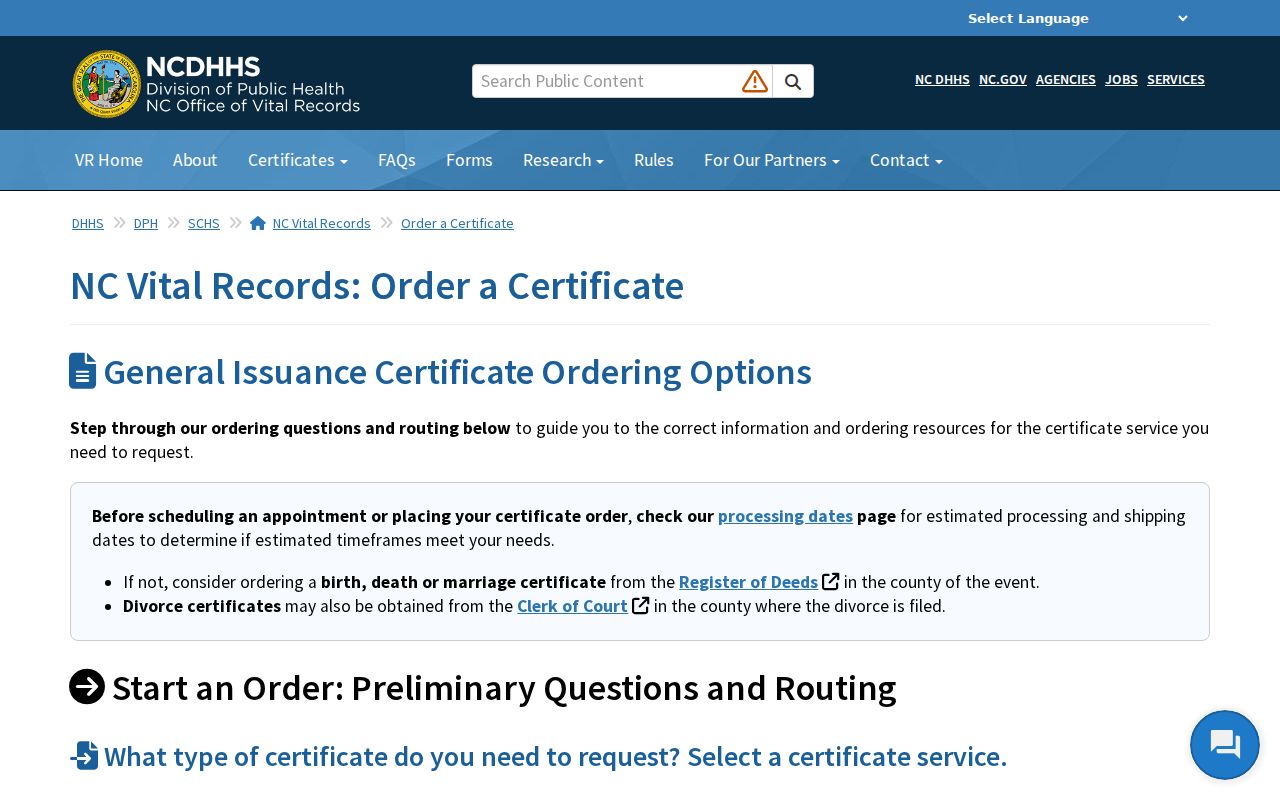
For a Guilford certified request, government photo identification is required and the county lists eligibility for the registrant, specified close family and direct relations, authorized representatives, and statutory exceptions. A certified copy is a custodian-issued product, not confirmation that a public index is complete. If the record is older or unavailable through the online path, use the county custodian, Clerk of Superior Court, or State Archives route identified for that event.
Greensboro Historical Resident Checks
For a former classmate, relative, heir, or earlier address, published sources add the date that current records lack. Greensboro city-directory runs span 1879/80 through 1981/82 in listed runs, with digitized core material from 1884 to 1963 and later or suburban originals listed by local repositories. The city burial index has more than 35,000 entries, while Union Cemetery is a separate historical route. Directories, newspapers, yearbooks, cemetery records, and estate files can support a dated connection, but no one source supplies a complete life record.
An heir trail begins with a Clerk of Superior Court estate or special-proceedings search, then the permitted paper estate file. Names of the decedent, executor or administrator, notices, dates, inventory, and final accounting can be cross-checked against later deeds. For any person-facing record, retain the source date and source type. That makes a correction or a conflicting match easier to handle with the actual custodian.
Limits on Greensboro Resident Lookup
North Carolina Public Records Law, N.C.G.S. Chapter 132, opens public records subject to record-specific exceptions. Sensitive identifiers may be redacted under N.C.G.S. §132-1.10. The North Carolina Address Confidentiality Program can provide a substitute address for eligible survivors, and voter protections withhold protected physical addresses. Utility billing, DMV information, protected birth data, sealed or expunged cases, juvenile records, and confidential proceedings have separate limits. A lawful public deed or historical listing is not erased by a broad request, but a wrong record should be brought to the custodian that holds it.
Lawful use. Use Greensboro resident records for personal, civic, family-history, estate, or consumer-safety research. Do not use a name, address, or record trail to stalk, harass, intimidate, or harm anyone. Stop when a record is protected and contact the responsible office for the lawful procedure.